
Get SHE’S Daily Newsletter | Subscribe Here


Beach Houses That Prove the Coastal Dream Is Still Very Much Alive
Disclaimer. Some images featured in this article may originate from third-party sources and are used for illustrative purposes. Please review our Image Credits Policy for attribution information.
I fell in love with beach houses before I ever lived near the ocean. It started with a photo I saved on my phone years ago. I remember well it was on my iPhone 5, a white clapboard front, a porch with a single chair, the sea just visible beyond the door. I could not explain why I love it since then. But what I wanted is the same style I want to apply to my beach house when I get one.
Beach houses have a way of making the everyday feel lighter. The air in them feels different, even in photographs. The light does something to the walls that you cannot replicate, no matter how much white paint you use.
I grew up landlocked. My relationship with coastal living was built through images; I did not notice at first how much those images were shaping what I wanted from my own home.
It was not the sand or the sunsets I was chasing. It was the feeling of ease.
Beach houses do that better than almost any other style I have ever studied. They make rest feel like the whole point. They make the inside and outside feel like one long conversation, which I love even more.
I started paying attention to the details that made certain homes stop me mid-scroll. It was never just the ocean view. It was the ceiling material, the way a sofa sat low to the ground, the stripe on a cabinet front that should not have worked but did. In general, the small things that added up to something at the end.
These homes are the ones I kept coming back to. Each one does something specific and worth paying attention to.
In this article
- All White on the Outside Makes Every Detail Count
- A Bedroom That Treats the View as the Main Design Element
- An Outdoor Sitting Area That Makes Staying Inside Feel Wrong
- Ribbed Cabinet Fronts and Rattan Pendants in a Coastal Kitchen
- Bamboo Cabinetry and a Turquoise Backsplash That Earns Its Boldness
- Rattan Ceilings and Layered Natural Materials in an Open Plan Interior
- A Modern White Exterior With Warm Wood Accents That Ground the Whole House
- Native Landscaping and a Stepping Stone Path That Sets the Tone Before You Enter
- What to Know Before Designing a Coastal Home
- What the Best Beach Houses All Have in Common
- She Notes
All White on the Outside Makes Every Detail Count
When a beach house goes fully white on the outside, every architectural detail suddenly carries more weight. The shape of a window, the pitch of a roofline, the depth of a balcony railing, all of it becomes visible. White does not erase personality. It reveals it.
A half-hearted white with too many contrasting elements loses the calm. But when the whole exterior is unified in soft white, the house begins to read as one quiet, intentional object against whatever surrounds it.
This approach works especially well close to the water because the surroundings provide all the color the eye needs. The sea does the work. The sky does the work. The house simply holds its ground.
Exterior white paint from Benjamin Moore or Sherwin-Williams in a durable satin finish runs between $60 and $90 per gallon. Benjamin Moore Chantilly Lace and Sherwin-Williams Alabaster are two favorites widely available at most paint retailers.
A Bedroom That Treats the View as the Main Design Element
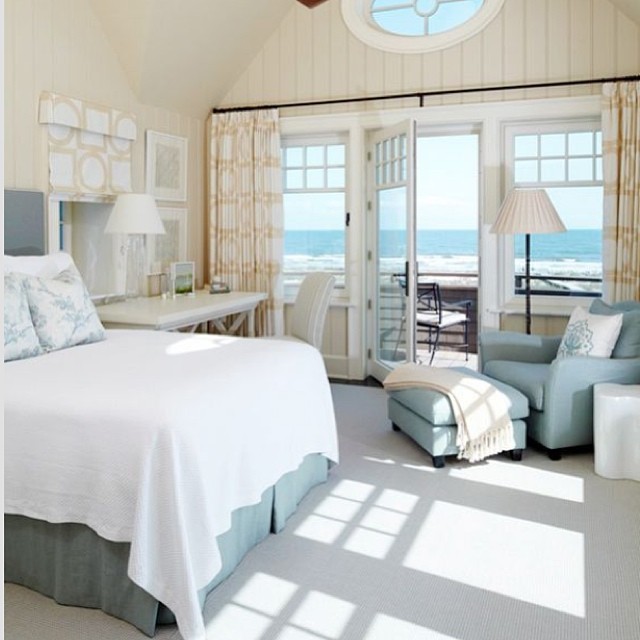
A bedroom designed around an ocean view does not need to compete with what is outside. The best ones keep everything inside soft, quiet, and deliberately understated so the window becomes the real focal point of the room. Pale blue upholstery and cream linens are not filler choices. They are the whole strategy.
The coastal bedroom approach works because it relies on light doing what furniture cannot. When morning sun comes through sheer curtains and lands across a white coverlet, the room earns its beauty without a single decorative object placed to impress anyone.
A reading chair tucked near the balcony doors makes the room feel complete in a way that no artwork or headboard statement can match. It tells anyone who walks in that this space was designed for actually living in, for sitting quietly and doing absolutely nothing, and that is exactly the point.
A boucle or linen upholstered accent chair in pale blue runs between $300 and $700 at places like Article, Wayfair, or West Elm. A white cotton coverlet starts around $80 and instantly shifts a bedroom toward that soft coastal feeling.
An Outdoor Sitting Area That Makes Staying Inside Feel Wrong
There is a specific kind of outdoor sitting area that makes you resent every indoor sofa you have ever owned. It is low, open on at least three sides, and positioned so that the water is not just visible but a part of the room
A built-in white platform sofa with a single flat cushion and two oversized striped pillows is not a complicated idea. It is a committed one. The commitment is to simplicity so complete that nothing distracts from the water, the breeze, and the particular kind of quiet that only open-air spaces near the ocean seem to hold.
Natural textures overhead, exposed beams, or a timber pergola ceiling keep the space grounded so it does not feel like it is floating. The contrast between the rough ceiling material and the clean white seating below is what gives this kind of space its character.
Outdoor platform daybeds in white or cream can be found at CB2 and Serena and Lily for between $800 and $2,500. Striped outdoor cushion covers start around $40 each at H&M Home and IKEA, making the styling portion very achievable.
Ribbed Cabinet Fronts and Rattan Pendants in a Coastal Kitchen
The coastal kitchen has moved well past shiplap and shell motifs. What keeps appearing now is something more considered, ribbed or fluted cabinet fronts in soft muted tones paired with woven pendant lights that hang at different heights and do not match perfectly. The result is a kitchen that feels handmade and specific.
Pale blue-green ribbed cabinetry against a white worktop and a thin stripe of patterned tile near the ceiling is the kind of detail that rewards people who look closely. It is also the kind of kitchen that photographs well in natural light without any styling effort.
Rattan or seagrass pendant lights are the finishing move that keeps the whole space from feeling cold. They introduce warmth and natural texture without adding color, which matters in a palette this restrained. If you are rethinking a kitchen for one of your beach houses or any coastal-leaning space, the light fixture choice is where the personality lives.
Woven rattan pendant lights start around $60 at IKEA and go up to $300 at Serena and Lily. Ribbed MDF cabinet fronts for a DIY refresh run between $200 and $600, depending on kitchen size.
Bamboo Cabinetry and a Turquoise Backsplash That Earns Its Boldness
Warm bamboo cabinetry is one of those material choices that reads completely differently depending on what surrounds it. Pair it with the wrong countertop, and the whole kitchen feels heavy. But set it against a bright turquoise subway tile backsplash under a vaulted ceiling with exposed wood beams, and suddenly the warmth becomes the best thing in the room.
The bamboo and turquoise combination works because both materials reference the same outdoor world. Bamboo grows near warm water. Turquoise is the color of a shallow tropical sea.
High ceilings with exposed beams keep this kind of kitchen from feeling enclosed. The volume above the cabinetry is as important as the cabinetry itself. A beach house kitchen designed with ceiling height in mind feels great in a way that no amount of open shelving can fake.
Bamboo kitchen cabinets run between $150 and $400 per linear foot installed, available through specialty suppliers like Smith and Fong Plyboo. Turquoise or teal subway tiles start around $5 per square foot at Tile Bar and Floor and Decor.
Rattan Ceilings and Layered Natural Materials in an Open Plan Interior
The beach house interior that uses rattan or woven cane on the ceiling rather than the walls is doing something specific and worth understanding. It brings warmth and texture to the one surface that most interiors leave entirely blank.
When that ceiling material is paired with raw timber, cane-backed dining chairs, a low-slung linen sofa, and a concrete or plaster wall finish, each material balances the others without any single element taking over. This is what is meant when people talk about layering natural textures.
A sleeping alcove tucked behind woven sliding panels in an open-plan space solves a design problem beautifully. It gives privacy without a full wall, maintains the airiness of the open plan, and adds an architectural moment that makes the entire space feel more interesting. It is the kind of coastal home idea that only makes sense when you actually see it working.
Woven rattan ceiling panels can be sourced from specialty suppliers for between $8 and $25 per square foot. Cane-backed dining chairs start around $150 each at Article or West Elm. A round reclaimed wood coffee table runs between $200 and $600 at most furniture retailers.
A Modern White Exterior With Warm Wood Accents That Ground the Whole House
A tall white modern beach house with clean horizontal lines and a standing seam metal roof reads as contemporary and confident rather than cold when warm wood elements are introduced at the entry level. Timber garage doors, a timber entry surround, or warm wood cladding on a single section of facade is all it takes to keep a very white, very modern house from feeling like it belongs in an office park.
The tropical landscaping matters here as much as the architecture. Palms, wide-leaved plants, and loose natural plantings soften the geometry of a crisp white building without making it feel informal.
Elevated construction on a coastal site also brings an honesty to the design. The house is not pretending that the water is not there. It is built with the water in mind, with sightlines calculated, with height used purposefully. A beach house that takes its site seriously always reads as more intentional than one that could exist anywhere.
Standing seam metal roofing costs between $10 and $16 per square foot installed. Custom timber garage doors range from $2,000 to $6,000 depending on size and species. Cedar and western red cedar are popular coastal choices available through most custom millwork suppliers.
Native Landscaping and a Stepping Stone Path That Sets the Tone Before You Enter
The front approach to a beach house tells you everything about the philosophy inside. A stepping stone path made from reclaimed timber or irregular slate, set through loose gravel and surrounded by native grasses and low coastal shrubs, signals immediately that this is a home that works with its environment rather than against it.
Native coastal planting requires very little once established. The grasses move in the wind. The low shrubs hold their shape through salt air and dry spells. The overall effect is of something that grew rather than something that was installed, and that distinction is felt even if it is not consciously identified.
The fringe umbrella on the terrace visible from the garden path is a small detail that carries significant warmth. It says that this is a home where people actually sit outside, where the outdoor spaces are used and loved rather than staged.
Reclaimed timber sleepers for a garden path run between $10 and $25 each and are available through salvage yards, Gumtree, and Facebook Marketplace. Native coastal grasses like lomandra or poa cost between $8 and $20 per plant at most garden centers and nurseries.
What to Know Before Designing a Coastal Home
Salt air accelerates wear on metals, paints, and untreated wood. Always choose marine-grade hardware, exterior paints rated for coastal environments, and timber species known for durability near water such as teak, cedar, or ipe. Powder-coated aluminum is a reliable choice for railings and outdoor furniture frames in high-salt locations. For interior fabrics, solution-dyed acrylic and performance linen hold their color and resist mildew far better than standard upholstery fabrics. Investing in the right materials from the start saves significant cost and effort over time and keeps a coastal home looking intentional rather than weathered in the wrong way.
What the Best Beach Houses All Have in Common
The homes that keep appearing on saved lists and shared boards are not always the biggest or the most expensive. They are the ones that feel like they were made for the place they sit in. That specificity is what separates a great beach house from a generic one.
Every material choice in a coastal home is tested by its environment in a way that inland homes are not. Salt air, humidity, and strong light all push back against things that do not belong.
The relationship between inside and outside is also non-negotiable in coastal design. Rooms that do not connect visually or physically to the outdoors feel wrong near the water.
Color is used differently here, too. The restraint that marks the best beach houses is about choosing color from the surrounding landscape and using it sparingly so it lands with real impact.
She Notes
The coastal aesthetic that feels most alive right now is the one that pulls away from the matching set and the catalog look. It mixes materials that have history, keeps palettes grounded in what the surrounding landscape already offers, and treats the outdoor space as seriously as any room inside.
Some homes you study. Some homes you simply feel. The best beach houses are the ones that make you feel something before you can name what you are looking at. Always remember that.